
You fixed how you say it. But the problem is somewhere else.
What the leaders whose strategy succeeds do about the half of communication they can’t control.
by Leonardo Zangrando, Leadership Communication Advisor

Every time you realise that your people don’t get your strategy, you focus on fixing your leadership communication. But this approach keeps you looking in one direction only, at you, the person speaking. Never at what happens on the other side. You focus on what you say, how you say it, how you can be more assertive, more empathetic, more compelling. And it helps, to an extent. You focus on clarity. But being clearer will not fix the core issue.
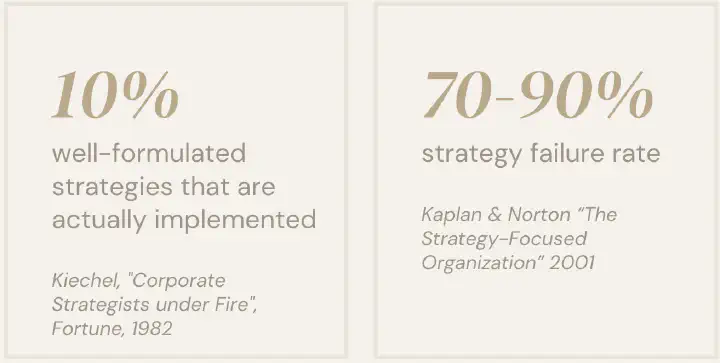
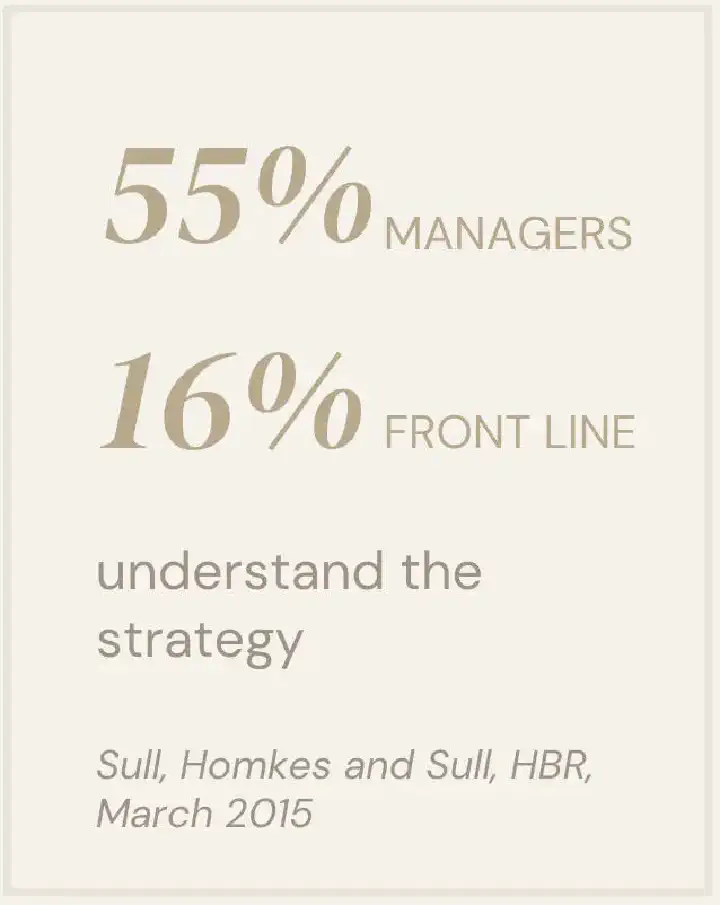
Communication is the key leadership tool to make things happen. The leader’s responsibility is to make their strategy happen through the people they lead. To do so, they need to make themselves understood and interpreted correctly by their people. Yet this responsibility is consistently undermined by leadership communication practice, exactly at the point where speaking should become leading.
This gap has gone unattended for ever. Now it has a name.
When was the last time this happened to you?
You got asked the same clarifying question for the umpteenth time. What is the matter? Why do they not seem to understand? I thought I was clear.
Or you had to herd your teams after an important announcement. You told them clearly, you said “go there”, and they went all over the place.
Or you presented to your board, and you saw that they were not getting it.
The first few times this happens, you might think it is them. Why don’t they get it? When it becomes a recurring pattern, you do what any good leader does. You ask yourself, maybe it’s me. And you try to be clearer, more articulate. When that gives only marginal results, you look for external support. Your comms team, a comms agency, speaker coaching, leadership coaching. And you get good enough, but just enough to call it done.
It has consequences
Not just the direct consequences of going the wrong direction. The misreading makes them decide something about you. The board questions the person, not the plan. And your people question your ability to lead them.
The irony is that you keep suffering the misalignment, because your instinct to correct yourself is right, but it makes you look away from where the issue really lives.
The big comms misconception
Everything we do in comms touches what the leader says, how they say it, how they can be more assertive, or authoritative, or empathetic. It focuses on all the aspects which are under the leader’s control, and it implies an assumption: that the leader’s responsibility is limited to the things they can control, while missing the half that decides whether any of it lands.
A leader has to lead. These controllable actions can make the task easier yet miss a crucial point. To lead, a leader must be interpreted correctly. To lead effectively, they need to make sure they will be interpreted correctly by their people, with no leeway. And this cannot be controlled the same way as all that comes before. Hence, it is never touched by the preparation.
That is often mentioned as the reason why a strategy failed or underdelivered. Because they misunderstood it, because they didn’t listen, because they didn’t get it. And when you tell the board, they expect you to lead and achieve results, not to herd people.
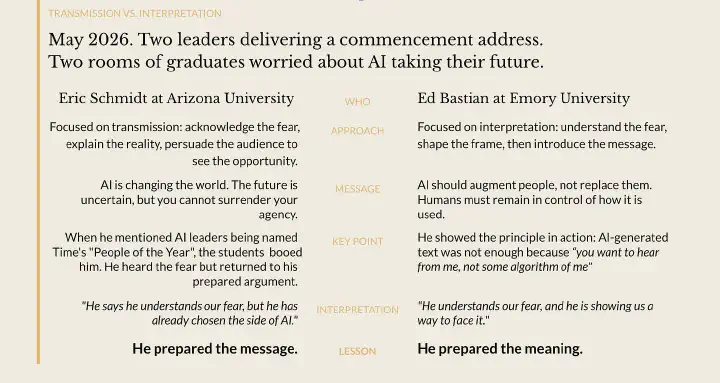
The Interpretation Gap
The Interpretation Gap is the other half of communication. The forgotten one. It covers the distance between what you mean and what your organisation actually does.
A leader must lead their people, but can’t control them. It sounds like a koan, a paradox used by Zen teachers to go beyond conventional thinking and discover insight.
But is it really a paradox? Beyond direct control, there is another form of leadership that aims to shape the understanding and interpretation of people to align them with the leader’s intentions. It’s not exactly influence. Nor it’s manipulation. It’s what I call the Interpretation Gap. It’s about focusing not only on oneself to make transmission impeccable, but also on the other side of communication. The one we believe is outside our control and take as an externality. That is, interpretation.
Sure, interpretation happens in the receiver’s mind. So it’s technically beyond the leader’s direct reach. Yet the leader has to lead, among all externalities, and take all of these into account. This is the most important and the most unaccounted for.
To be fair, there are leaders who naturally see the interpretation gap and manage it. But treating it as a gift frames it as a soft skill. In the past the solution could have been a generic “be more empathetic”. Now we want an ability that is measurable, can be learnt, and produces actual results. Not just a gift that some leaders possess and others don’t.
Closing the Interpretation Gap is a key success factor for leaders, to align their organisations and allow their people to focus on creating value rather than navigating misinterpretation. Then it is the leader’s task to close it again every time it reopens.
What I kept seeing
For over twenty years in strategy consulting, I watched leaders work every tool in the communication playbook. What they say, how they say it, how to be more compelling. Then I made the same mistake when I had the chance to work with dozens of TEDx speakers and corporate leaders, to help them become better communicators.
And this gap is not just about leadership. We all live it daily. Every time we say something we think is perfectly clear and people make something else of it. We repeat, we explain more, and we get frustrated. The same gap, experienced personally.
The leaders whose strategy actually lands are doing something different. Not “better communicators”, but leaders who take charge of how they will be interpreted. I keep seeing five things that these leaders consistently do.
Clarity, of intention and desired result.
Reception, how you will be heard by the people you will be addressing.
Architecture, of your message, how to say the right thing at the right time.
Friction, where and how you could still be misinterpreted.
Truth, the moment of truth, when you are alone at the front addressing your people.
A structured approach to these five CRAFT dimensions can be learned and accelerates alignment between the leader’s intent and their people’s interpretation.
The first two are essential practices that are taught consistently from the transmission side, but taken alone are not enough. Architecture is a second-order issue: the sequence you say things has a direct implication on how you will be interpreted. Friction is a very focused practice of hearing what else could be interpreted in your words.
The Moment of Truth is the only thing of all five which is exclusively the leader’s to own. It’s when no external support is at hand. No comms team, no coaches, no one else but the leader. And their people.
What you can do
Pick the few moments. Do not go full-scale to start with. Pick just the few moments where interpretation is crucial. Work on them, and realise whenever your message might be misinterpreted.
Know what you want to change in them. Approach any conversation, any meeting, any piece of communication knowing exactly what it is that you want to change after you deliver it. What do you want to change in them? Not in you, but in them. Their beliefs, their understanding, their behaviours, their actions.
Change the question you ask afterwards. After a meeting or a presentation, do not ask yourself how it went. Ask them what they took away, and what they will do differently.
What comes first decides what lands. Think very carefully about how your words will be interpreted depending on what you said before. So organise your presentation, your meeting, your message to start with the things they need to know and understand, the things that will ground them for the big piece of news you are going to deliver after that.
Let someone find the wrong reading. Even with the most careful preparation, you can be misinterpreted on single words, on single pauses. So before this happens in the room, take the time to test it with someone external, someone who is not you, because for you the clarity is already there. Someone external can tell you what the most reasonable way to misread you could be.
Be present, and allow yourself to stop. Remember, when you are there, be present and sense what is going on in the room. If you see that your script is not working, or that something is happening against it, you are allowed to stop and take stock of what is going on. Name to yourself what you have noticed, and deal with it before going on.
Yes but…
“This is not a communication problem. The plan is wrong for the situation.”
Yes, this could be true. The plan could be wrong for the situation, and in that case there is nothing interpretation can do about it. But when the plan is good and it is executed through different interpretations by different teams it will underdeliver. This is the point. If everybody moves in the same direction and they fail, it is the plan. But if everybody went in different directions, then it was a matter of interpretation.
“Communication is the cherry on the cake. Get the right people, systems and incentives and it takes care of itself.”
When I hear this, I look at the leader I have in front of me. Most often it’s a successful leader, and I am a hundred per cent sure that they are already managing the interpretation gap so that the transmission lands correctly. They do not need the support of comms or speaker coaching, because they are already doing it. They are already taking responsibility for the interpretation part.
“It isn’t all mine. Surely it’s fifty-fifty.”
When I hear this, I see a leader making a perfectly accurate observation. Interpretation happens in their mind, but is co-created with you. And the fifty-fifty is not where we usually put it. We picture a line in the middle, with the sending on our side and the rest on theirs. The sending is a hundred per cent yours, and what they finally do with it is a hundred per cent theirs. The fifty-fifty sits in the gap between the two, and it is not a turn each, first you and then them. It happens at the same time, while they are making sense of what you said, and you can only do your half while it is happening. Not to force interpretation, but to make it easier for them to interpret it the way you intended.
Why that half is yours
I’ve heard these objections time and again. They are usually reasonable motives to stay away from the unknown. Because interpretation is the unknown part of communication. While focusing on transmission gives us a strong sense of agency, focusing on interpretation feels like a lost battle. But it’s not a battle against your people, it’s the leader’s responsibility to be on the same side with their people to make the organisation successful.
You do it already whenever you choose what to say and what to withhold, who to say what. You do it naturally, but when it becomes hard, you forget it and revert to the prescribed medicines.
You were never unclear. You were misinterpreted. Being clearer will not fix that. Closing the Interpretation Gap will. That half is yours, and no one can close it for you. Every time it reopens.
AI for once can really help
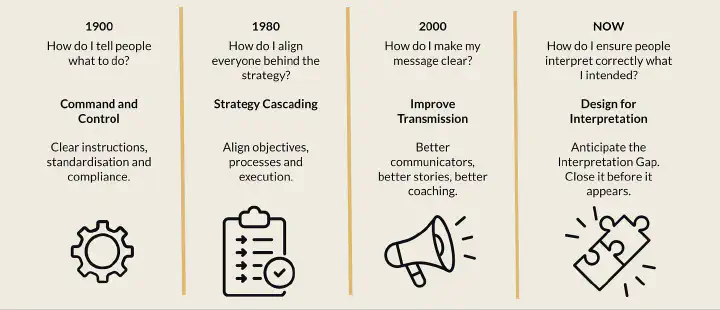
This change is not driven by AI. It is the natural evolution of leadership. But now AI is everywhere. How will AI influence this trend? I see 2 options.
The bad use of AI. The number of badly written memos and communications that smell AI from afar is rapidly growing. AI is not good at writing in your voice with your ideas. It is even worse at being there alone with your people.
The good use of AI. AI is already good at spotting inconsistencies, identifying trends, helping you align your thoughts. Used well, it can support a leader across all five areas of CRAFT without replacing them. Rather, augmenting them.
So what does that look like in practice?
Imagine having someone to challenge your thinking whenever a high-stakes communication is approaching. Not to write your message. Not to tell you what to say. But to test how your words are likely to be interpreted before anyone else sees them. To surface the interpretations you haven’t considered. To identify the place where clarity is most likely to break.
A few leaders already do this, with a tool in their pocket for the moment there’s no one to bounce a message off before it goes out. It’s called Drift.
Drift is a conversation on WhatsApp.
Before the meeting. Before the board paper goes out. Before the town hall. Before the strategy document is shared. Before the difficult email is sent. Bring Drift whatever you’re about to communicate.
Together, you’ll stress-test how it’s most likely to be interpreted. You’ll identify the most reasonable wrong reading and uncover where your intended meaning is most likely to drift away from what people actually hear.
Drift lives in your pocket, ready for the moments when there isn’t another trusted leader to challenge your thinking.
How is your next year as CEO going to change if you manage to make this approach the norm even when things are hard?
Just bring your next high-stakes moment and start the conversation: https://wa.me/447472089874?text=Drift
Three complimentary analyses No app No registration No credit card No commitment Just value
If it’s as useful as I believe it will be, I’ll be glad to have you among the first leaders to take it further.
About the author
Leonardo Zangrando is the founder of Talk for Impact, a leadership advisory for CEOs, managing directors and founders of scaleups and growing companies.
He works with leaders on the gap between what they mean and what their organisation actually does, so the strategy that leaves the room is the one that gets executed.
With an MBA from IESE Business School in Barcelona and over twenty years in corporate strategy consulting, he has advised leaders across retail, technology, media, pharmaceuticals and logistics, in companies like Tesco, Google, BBC, Booking.com, Fremantle Media, Novartis and Salesforce.
Italian-British, working across English, Italian and Spanish-speaking environments, he brings what he calls the foreign ear, an acute sensitivity to how meaning shifts across languages, cultures and hierarchies, and to the precise moment where interpretation diverges from intent.
He is the author of the CRAFT in Action series, which applies the method to real leadership moments. He is currently writing his main book on the leader’s responsibility to close the gap.