
You finally get the room to yourself. Watch what you protect.
At the opening of his own presidential centre, Barack Obama had complete control over how the story would be told, and chose not to point at himself to prove it.
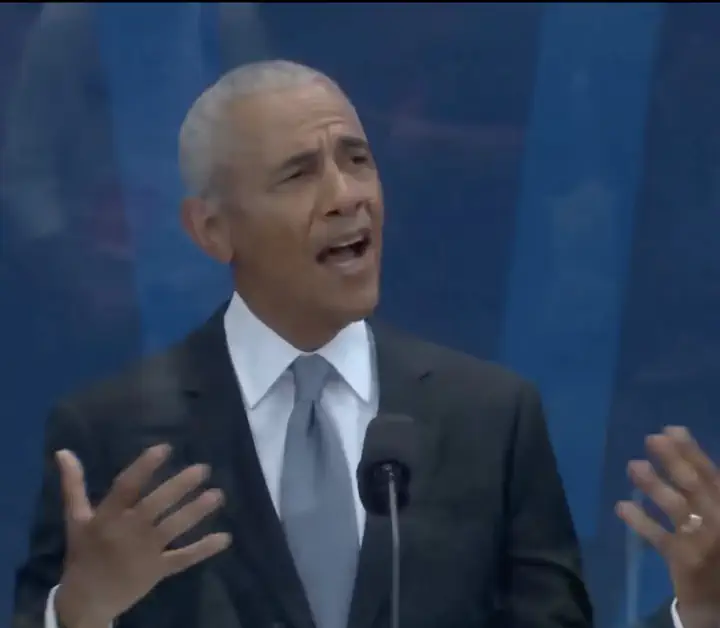
This June, in Chicago, Barack Obama stood in a building built entirely around his own story and told the people in front of him to skip the parts about him.
Three other presidents were in the room. Bush, Clinton and Biden. His daughters, Sasha and Malia, were there too. The Obama Presidential Center had just opened on the South Side, on the very spot he says he first drove into in 1985, in a used car so full of everything he owned that he could barely see out of the rearview mirror.
What you would do with the room
Every choice in that building, what goes on the walls, what gets a room of its own, what gets left out entirely, carried his name and his intent behind it. Nobody was going to overrule him on what story it told.
And then, if visitors only had a day, he told them to skip the clips of his speeches. “You have heard them all before,” he said. Go and look at the ordinary people instead. The cancer survivor who feared rising premiums would force her out of her home. The teenager who told him she was scared her father would lose his job in the auto crisis.
Later in the same speech, without anyone asking him to, he pointed at his own exhibits and said some of them reflect unfinished business, in some cases his own shortcomings and mistakes.
That is an odd thing to build into a monument to yourself.
Here is what you would expect instead. When you finally get the one platform built entirely around your own name, you protect it. You choose the strongest quarter, the cleanest version of the decision that worked, the angle that holds up best under a passing glance. You leave the failed initiative out of the retrospective, the resignation out of the leaving speech, the missed target out of the anniversary post. Nobody is forcing you to include the parts that cost you.
What he did with it instead
Obama had every reason to do that, and the material to do it well. He built something else instead. A centre like this exists to prove you were a great president. Nobody would have blamed him for spelling it out directly. Instead, he built the case out of other people’s outcomes rather than his own record, the cancer survivor whose story became the reason for healthcare reform, the teenager whose father kept his job because of the auto bailout. He was still proving something. He just never had to say it himself. He also left his own admitted failures on the wall of the building built around him.
Authority that keeps having to explain itself was never quite as secure as it looked. The version of confidence that needs a room like that shaped in its favour is the version that suspects, somewhere underneath, that it would not hold up under a fuller account. Obama’s did not need the shaping. When it did show up, it ran the other way.
The next monument that is entirely yours
You will get a smaller version of this moment eventually. Quieter, likely lower stakes, but essentially the same shape. The annual address where you get to frame the year in your own words. Or, someday, the retirement speech, if you are lucky enough to choose when you give it. Nobody else will be in that room shaping it for you. It will be entirely yours.
Notice, when it comes, what you find yourself wanting to leave out. Leaving it out is not automatically wrong. But the thing you are most tempted to protect is usually the thing telling you the truth about how secure you actually feel underneath the version people see.
The size of the room isn’t the point
It is tempting to say this is easy for a man with nothing left to prove as president, whose legacy does not turn on how one museum’s opening day goes. That gets the mechanism backwards. The instinct to over-curate your own moment does not shrink as the stakes shrink. It shows up in the founder writing the tenth-anniversary post, and in the CEO drafting the note about a reorg that did not go the way the board expected. The size of the room changes how visible the choice is. It does not change whether you make it.
The room you finally get to yourself is not a reward. It is a test, and what you protect inside it is the answer.
You will not always be able to tell, from inside the room, which one you actually gave them. That is where Signal comes in. It helps you understand, after the moment has passed, whether what you protected served you or worked against you, so the next room you get to yourself, you notice it while you are still inside it. Try it at app.talkforimpact.com/try/signal