
When the room has already decided
You prepared the message. Nobody prepared the room.
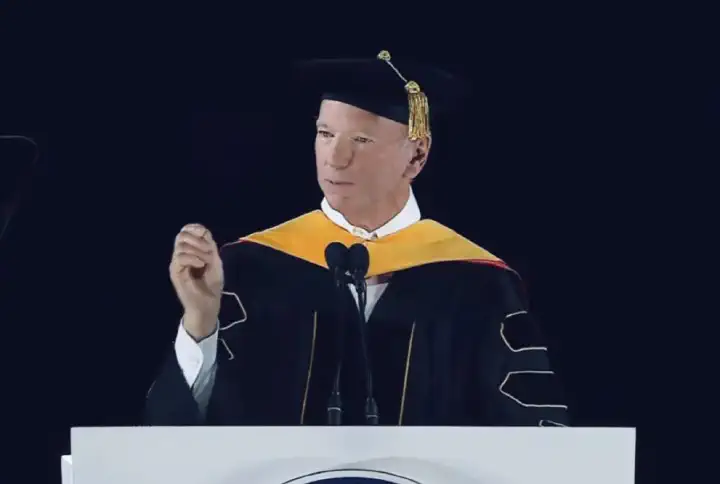
The boos started at 3:06.
Eric Schmidt was at the podium at the University of Arizona, May 2026, mid-sentence about AI and the future of the graduates in front of him. He hadn’t finished the thought. The room didn’t wait.
He kept going.
Twelve minutes of public record, in one room that he would not win.
He knew.
The opening of that speech is not accidental. Schmidt spends the first two minutes confessing. His generation built the internet in a spirit of optimism, they believed connecting every human being would be “an unambiguous good.” And then: “the world we built turned out to be more complicated than we had anticipated.” The same tools that connected people also isolated them. The same platforms that gave everyone a voice also degraded the public square.
He says this before asking for anything. That is deliberate. He mapped what the room was carrying, and built an opening that acknowledged it. A room of people afraid of what AI is doing to their futures, addressed by one of the architects of the technological world that produced those fears. He knew the filter he was walking through.
And still the boos came.
What acknowledgment does not do
At 3:26 he says: “I can hear you. There is a fear.”
He holds it out. He names it specifically: “the jobs are evaporating, the climate is breaking, the politics are fractured, and you are inheriting a mess you did not create.” He stays in it for perhaps thirty seconds.
Then, by 4:09, he is already at the pivot: “to speak of the future as though it has already been decided is to surrender the one thing that actually matters. You are surrendering your agency.”
The line is worth reading again. “You are surrendering your agency.” He has named their fear, and then, in the same breath, placed the burden of it back on them. Stop inheriting the mess. Start owning the future. The room was still carrying what he had just acknowledged. The pivot did not just come too fast. It asked them to carry more weight than they had arrived with.
Less than a minute between naming the fear and asking something of the people carrying it. The message architecture was right in design and too compressed in execution. The room had not finished receiving the hard thing before the next thing arrived.
The CEO who opens an all-hands with “I know this restructure is hard” and moves to the roadmap in the same breath. The one who announces redundancies and pivots to the opportunity in the next paragraph. Both do the same thing: the acknowledgment is real, the pivot is too fast.
Not between what you said and what you meant. Between when you moved on and when the room was ready to follow.
The 2026 version
AI makes this sharper because the fear is more acute and more personal than most things a leader has to address in a room.
A restructure affects some people. A strategic pivot affects the organisation’s direction. AI, as the graduates at Arizona were hearing it, threatened every person in the room, in their specific chosen field, before they had drawn a salary from it.
Schmidt’s pivot, “the question is not whether AI will shape the world, it will, the question is whether you will help shape it,” is architecturally correct. It asks a very large thing of people who are still at the fear. It asks them to move from “this technology may take what I worked for” to “this technology is yours to direct” in forty-five seconds.
If you lead a team right now, you are dealing with some version of this. The room walks in already carrying a view about what AI means for them personally. You represent the person who gets to decide. You are cast before you open your mouth, not because your team is hostile, but because the stakes are real and the fear is well-grounded in reality.
You can prepare the message, have the facts, anticipate the questions, acknowledge the anxiety, and then make the case for the opportunity.
Schmidt had all of that.
What the message cannot do is shorten the distance between fear and trust on behalf of the room.
Only time in the discomfort does that. Actual time. Enough that the room feels you have genuinely arrived at their fear before you ask them to move past it.
He stayed.
The boos kept coming. He didn’t win the room.
He was solid at keeping the ground, but that is not an achievement at all. He kept going because that was the plan. The confession was designed, the acknowledgment was timed, the pivot was scripted. He executed what he had prepared, in front of people whose fear he had prepared for but not arrived at.
Nothing in those twelve minutes suggests he actually felt the room. That is the Moment of Truth gap. Not a failure of design. A failure of presence.
Ed Bastian, at Emory a few weeks earlier, rewrote his speech because he felt it was wrong before he delivered it. Similar occasion. Different arrival.
That gap, between what the leader intended and what the room received, is the whole problem.
And in 2026, in any room where AI is the thing nobody is fully saying out loud, it becomes visible faster than you expect.
If this landed, there’s more every week. The Leadership Last Mile — leonardozangrando.substack.com