
The room agreed. The building did not.
Your team agreed. Then each of them went and had the same meeting again, one floor down.
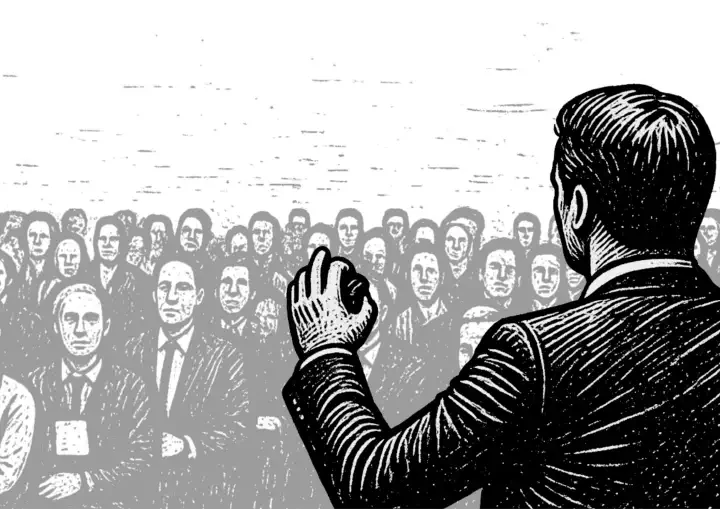
Think of the best leadership offsite you have ever been in. If you have never had one, think of the one you would want.
Two days, everybody there, phones face down. The arguing was real and it came early, and at some point someone said out loud the thing normally only gets said in the car park afterwards. By the end of the first day the list of things that mattered had gone from thirty one down to nine. On the second morning you all wrote down what you had agreed, and you read the sheets back to each other, and they matched. You left with one message, and for once every person in that room went out and said the same one.
Six weeks later a piece of work comes back to you.
It is good work, someone has put real effort into it. And it is not the thing you agreed. Not wrong, not sloppy, just built on a different reading of the same nine priorities. You look for the moment where it went off and you cannot find one, because there isn’t one. It was like that from the beginning.
The writing exercise did its job
That exercise on the second morning came from somewhere. Julia Dhar and her colleagues at BCG published it in Harvard Business Review this summer, and their word for what it catches is false alignment. A room where people say they are aligned and mean only that they are not in each other’s way.
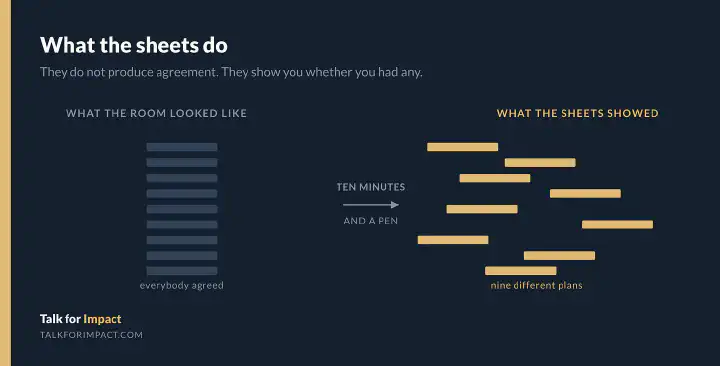
The fix takes a pen and a piece of paper. Everybody writes down on their own what we agreed, what is changing, and how it will work. Then you lay the sheets next to each other. If they do not say roughly the same thing, you do not have a plan.
It works because it does not ask anyone to argue. The people who disagree with you were never the problem, they already told you. It finds the ones who agreed with you while picturing something else, and nothing else finds those.
In your offsite it worked. Nine people walked in holding nine versions of the plan and walked out holding one.
Then it turns to everybody else
Once the top of the house is straight, the same plan has to reach the people who will do the work. Here the method changes tool. What it gives you for the rest of the organisation is a take up plan, and it asks three things.
Will they do it, because the incentives point that way. Can they do it, because they have the skills. Will they want to, because the motivation is there.
Every one of those is worth asking. Not one of them asks what the person understood.
So how is the workforce different?
You already know the answer to this, because you watched it happen.
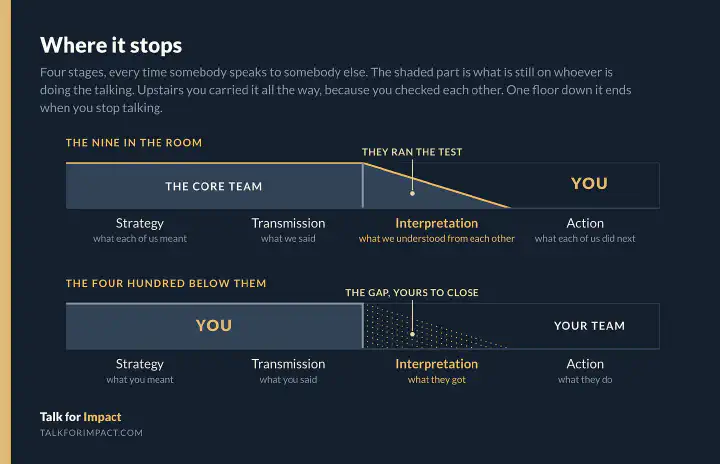
Nine capable people. All senior, all in the same room for two days, all agreeing out loud. And when they wrote it down on their own, the versions were not the same. That is not a study. That is your own offsite, last month.
So are the four hundred people downstairs better at this than your executive team?
There is research pointing the same way. Dhar’s team put an undescribed change to six thousand people in a dozen countries, a thousand executives and five thousand everybody else. Each of them was told a change was coming to their working life, and told nothing about what it was. Then they were asked how they felt about it.
Seventy per cent of the executives felt good about it. Fewer than half of everybody else did.
The usual reading is that the workforce is harder to move, and those three questions go to work on exactly that. Turn it round. Your executives will back something they cannot see the shape of. The people who have to do the work will not.
So what arrives matters more down there, not less. An executive can carry a half formed plan around for a month and still do the job. Somebody who has to act on it on Monday cannot.
None of that is an argument for sending them more. It is an argument for finding out what arrived.
If it is good enough upstairs
The test is not a big idea. It is a pen, a piece of paper and ten minutes, and you trust it enough to have run it on the people who set the strategy.
The people who have to make the strategy happen get the version with no test in it.
I cannot get four hundred sheets
You do not need four hundred. You need enough of the layer that is carrying it that a difference would show, and that is a handful of people.
And it is not the same question you asked in the room. Do not ask whether they understood, because that asks somebody to grade themselves in front of their employer, and almost everyone says yes. Do not ask what they think, because you will get what they think, which is not what you are looking for.
Ask what they got.
What did you come away with from your boss. In your own words. Then read what comes back against what you actually meant them to leave with.
And when it does not match, saying it again with better slides is not the answer. That is the move everybody already makes, and it arrives as though the person in front of you were the slow one in the room. It means what it meant upstairs. You do not have a plan yet.
Won’t that make me look unsure?
This is the objection that actually stops people, and it deserves a straight answer, because asked the wrong way it does stop you.
Was I clear? makes you look unsure. It puts your own performance in the middle of the room and asks for reassurance, and reassurance is what you will get.
What did you come away with? does not, because it is not about you. It is the most ordinary question in management. It is what you would ask anybody who came back from a meeting you were not in.
The offsite worked, and you know it worked, because you did the one thing that produces proof. You asked nine people to write down what they were holding, and then you looked at it.
The asking is free, and you should do it on Monday with two people.
The part that does not scale is the reading. Forty answers in forty people’s own words, held up against what you meant to happen, without grading anybody. That is the piece we have built, as part of CRAFT 91, the programme we run with leaders. It has not been out of the building yet.
It will not close the gap for you. Nobody can make somebody else understand a thing. It tells you whether what you meant arrived, which is the part you are currently guessing at.
If you want to be in the first group that tries it, join the waitlist , you’ll also get a quick snapshot of where your organisation stands now.
If this landed, there’s more every week. The Leadership Last Mileleonardozangrando.substack.com