
The leadership last mile: the part of communication no one can do for you
The speech can be written for you. The moment when you stand alone in front of your people cannot.
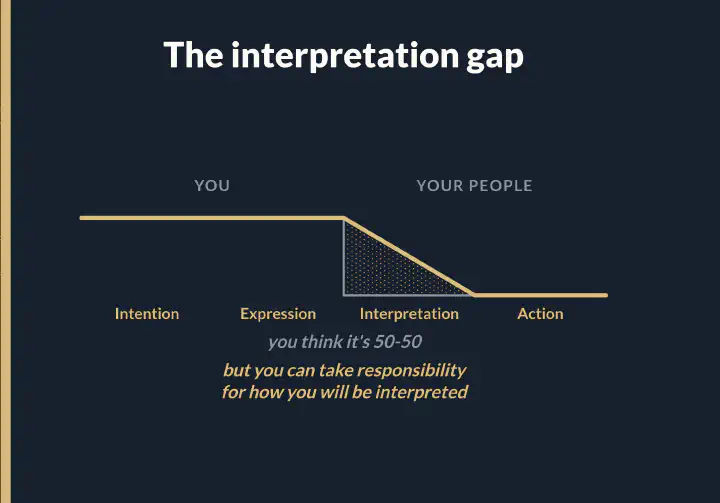
So you think you have it all sorted out.
You have a communications team that prepares your speeches. You have a speaker’s coach who helps you deliver them brilliantly. You have mindset coaches that make you confident and authoritative on stage, and so on. You think it is done. You are covered.
But there is one part you are missing: it is the leadership last mile, the moment when you are alone in front of your people.
The moment no one can reach
In that moment you cannot reach out to a comms team to define or to change the way you say something.
You cannot reach out to a speaker’s coach to decide how you would say something. And your mindset training is not enough to help you be there with your people.
This is the leadership last mile. It is the moment when the leader takes responsibility for how they will be interpreted by their people. It is the last mile of communication because no one else can be in that place but the leader.
The assumption behind all your speeches
All the time and effort you invest in your speeches rests on one assumption.
We normally look at communication as four steps: idea, transmission, reception, action. The idea and the transmission are my job as the leader. The reception and the action are theirs. You have an idea, you express it, and that is your task. Their task starts when they understand and act.
But that is not what happens. After the transmission, your job as a leader does not end. Between what you say and what your people do, there is a gap. It is your people who interpret what you said, transform it into an understanding, and then into action.
Up to the transmission it is all yours. Then comes the gap, and that part is fifty-fifty. It is a space of shared meaning creation, where you and your people create the meaning together. This is the interpretation gap, and the last mile is where it gets closed, if it gets closed at all.
Shared meaning
Shared meaning happens when you express your strategy and your people interpret it the way you intended. It is a process of co-creation.
There is a lot of research behind this, going back to the 1980s. Thousands of articles and studies look at how leadership turns into action through correct interpretation. The research uses two terms, sense-giving and sense-making, and they are two sides of the same effort.
Sense-giving is the leader’s side: giving their people the tools to understand and interpret the strategy correctly. Sense-making is the side of the people: how do they make sense of what is being told to them?
The leader’s objective is to create the conditions for their people to make sense of the strategy. Both parties jointly create the meaning, and that is why it is a co-creation effort.
When people are aligned around the same meaning, giving the same meaning to the strategy and to the way we plan to implement it, it is so much easier for the strategy to succeed.
Stay for a moment
Now imagine the difference when you finish your presentation, your interaction with your people, and instead of leaving and disappearing, you stay with them for a moment. You stay to actually see how they take it.
How did they take it? I have seen it time and again when a leader does this: their people respond in a way you would not have expected.
That reaction is the interpretation, visible for the first time. You cannot get it from a speech, from a coach or from a comms team. You can only get it by staying long enough to see it happen.
Watch, then close it
The recommendation is very simple: keep working after you speak, not only before it. Watch for the moment your people’s reading starts to drift from what you meant, and change something while you still can.
This is not a new skill added on top of the others. It is the same four things you already prepared, checked live against what is actually happening in the room. Did they take your intent the way you meant it? Is their reading matching what you expected from this group? Is the message surviving contact with the room, or is one specific word landing wrong? You already have the answers you prepared. Now you are testing them against what is real, and adjusting the moment they stop matching.
When a line lands differently than you expected, change something, a word, the pace, what you say next, rather than finishing the plan exactly as built regardless. That is not improvising for its own sake. It is closing the same gap you have been working on since before you walked in, except now you see it happening and can still do something about it.
To get there, prepare yourself. Get clear on your intent. Know how your people will receive and read what you have to tell them. Know the right architecture for your message. And know the points where friction can happen.
When you have these four, you have what you need to watch your people while you speak to them, notice where the gap opens, and close it before you leave the room.
«But this is one more thing to do»
I speak often about the leader’s responsibility to close the interpretation gap, all the way through the last mile of communication. It can seem daunting, something on top of the many issues a leader already has to deal with.
It is not. The key task of the leader is contained in the verb, to lead. This is how you lead: by staying active with your people through the last mile of communication, closing the interpretation gap as it opens, helping them make sense of your strategy so that they implement it the way you want. And that is for their success, yours and, of course, of the company.
The last mile is leadership
A perfect talk, perfect slides and a fantastic speech prepared by someone else can all lead up to the moment when you stand alone in front of your people. That moment is yours, and no one can take it from you.
You can hand over the writing, the slides and the rehearsal. You cannot hand over the last mile.
Find out where you stand
How do you show up in the last mile? Think of the moment after a presentation when your people surprised you.
Take a Snapshot : six questions about your last high stakes moment in front of your people, to see where you stand in your last mile.