
Not some algorithm of me
Ed Bastian already had the answer. He just didn’t apply it to himself.
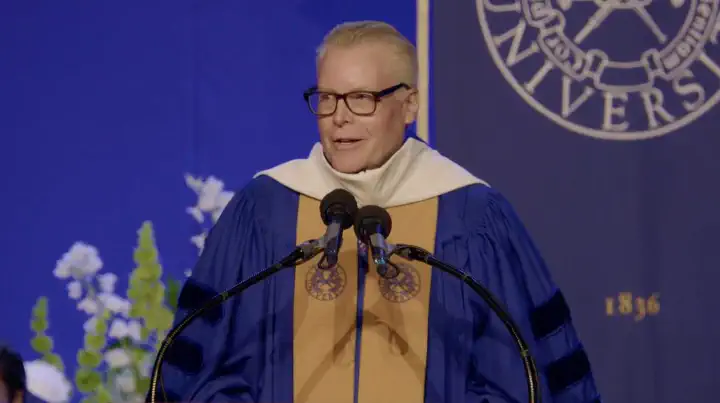
Delta CEO Ed Bastian was invited to deliver the commencement address for Emory University’s class of 2026.
He asked AI to write it. Read what came back. Found it had no soul, no warmth. Scrapped it, rewrote it by hand.
Then walked on stage on 11 May and told the graduates exactly what he had done.
That last part matters. It wasn’t a private moment of editorial discomfort. He named it publicly, in the room, in front of the people the speech was for.
He named it under his third lesson: character matters. Character isn’t revealed when life is easy. It is revealed when times and decisions are hard. Taking a shortcut or pushing the easy button can sometimes be quite tempting, he admitted. But shortcuts never yield an enduring result.
“You want to hear from me. Not some algorithm of me.”
What he found when he read the draft was not bad writing. The words were fine, but he was not there.
The part everyone quoted
That story has travelled fast. What the coverage carried: AI failed, the human won, lesson learned.
Bastian ran one test and found out AI couldn’t replace him. He’s right. But then he stopped.
Mark Zuckerberg is running the opposite experiment. Reports this year describe a photorealistic AI clone, trained on his voice and mannerisms, deployed in conversations across Meta’s 75,000 employees, so that he can be present in more rooms than he physically can. What he makes of that experiment, we are still finding out.
Both are testing the same binary. Can AI substitute for the leader, or not? Bastian says no. Zuckerberg is still finding out. But neither is asking the harder question.
The answer he already had
There is something almost every report left out. Earlier in the same address, before the easy button story, Bastian was describing how Delta deploys AI for its people:
“I like to refer to AI not as artificial intelligence, but as augmented intelligence. It ensures that our people know it’s there for their use and that they will lead its deployment, not have the technology lead them.”
And then: “Not technology for technology’s sake, technology for human’s sake.”
He has a framework. Augmented: the human leads, the technology serves. He believes this enough to say it to 100,000 people and to build his company’s AI strategy around it.
And then he ran a substitution experiment on himself.
He asked AI to write his speech. That is not augmentation. That is replacement. The framework he applies to his people, he did not fully apply to himself.
That gap is where the interesting question lives.
The moment without a proxy
Bastian is right that you want to hear from him. And the reason is structural, not sentimental.
When a person stands in front of other people and speaks, something is happening that is not primarily about words. The room is running a live assessment: is this person here, do they believe what they are saying, does who they are match what they are asking of us?
That assessment does not run on content. It runs on presence. And presence is not something you can write in advance, hand to a tool, and have delivered on your behalf.
A commencement address where a CEO speaks to the graduating class of the university in the same city as his company, in a moment that calls for someone to be present, calls for a person. An algorithm of that person is a different thing.
There is no proxy for that.
The half he didn’t test
We don’t know exactly how Bastian used AI in his process. He may have tried more than a single draft. What came back still didn’t feel like him, and that is what he reported.
But what the story is now used to settle is simpler than what it actually proved. The test ran from brief to draft. It did not test what happens when AI is used in the work that comes before a brief exists.
There is work that happens before the stage. It is not the same as the stage. Clarifying what a leader needs to happen in a room. Working out how the specific people across the table will decode what they say, and where the meaning they intend could be heard differently from the meaning they send.
This is hard to do alone. You are too inside your own intent to read the gap clearly. You see what you mean. You do not easily see how it lands.
AI can hold the other side of that conversation. It can surface the places where meaning slips, before you are standing somewhere it matters.
The conductor and the score
If AI shaped the thinking in preparation, hasn’t it already shaped what gets delivered?
A conductor works from a score they did not compose. They rehearse over weeks. By the time they walk to the podium, every moment of the performance has been prepared. And what the room receives is the conductor, not the score, not the rehearsals, not the work that made the night possible.
Preparation and delivery are not the same thing. The more thorough the first, the more fully present the second can be.
Bastian would agree. He has said it in so many words, for his people. Not replacement. Augmentation. The technology serves the person. The person leads.
The question Bastian left open
He settled one question. An algorithm of you is not you. That is closed, and he was right to close it.
What he left open is how the framework he already has, the one he gave his 100,000 employees, applies to his own preparation before a high-stakes room. He proved the delivery cannot be delegated. What he didn’t test is whether the preparation before it can be made richer, more intentional, more attuned to the specific room, with AI doing what Bastian said AI should do: augmenting, not replacing.
We have been running closed-door sessions with leaders on exactly this. An AI-supported preparation process that helps them think through what they want to say, who they are saying it to, and what is likely to stand between them and being understood, before they stand up. If you want to find out what that looks like, get in touch.
Which part of the last high-stakes room you walked into was preparation, and which part was you?