
He could have said it. He chose not to.
Choosing what not to say is the harder discipline. And it is always a choice.
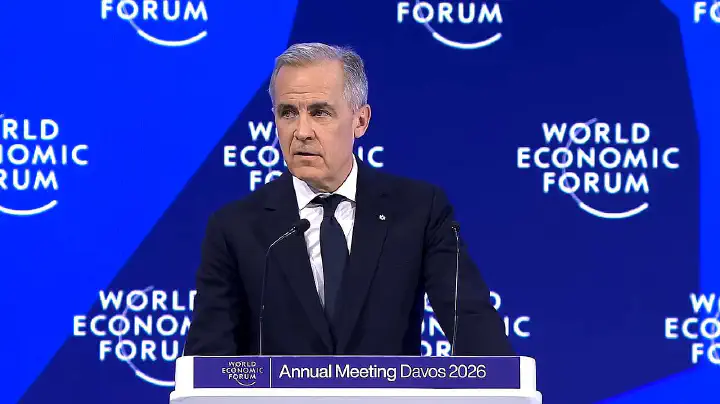
Credit: World Economic Forum/Wikipedia Commons CC-BY 4.0
Davos, January 2026. Donald Trump had been back in office for a year, and his trade war was in full swing. Most of the business leaders at the World Economic Forum had spent that year quietly restructuring their supply chains and reducing their dependence on the United States, while publicly calling it a short-term disruption they were managing carefully.
On 20 January, Mark Carney stood before them. Canada sends three quarters of its exports to the United States. Carney had been Prime Minister for less than a year. He was in the middle of the worst trade confrontation his country had faced in a generation.
He walked into that room and told them they were the greengrocer.
Not in those words. He told a story about Vaclav Havel, the Czech dissident who asked how the communist system sustained itself. Havel’s answer: a shopkeeper who places a sign in his window, “Workers of the world unite,” not because he believes it, but to avoid trouble. To signal compliance. To get along. “The system persists,” Carney said, “not through violence alone, but through the participation of ordinary people in rituals they privately know to be false.” Then: “Friends, it is time for companies and countries to take their signs down.”
The room rose.
What he did not say
He did not name Donald Trump once.
He said “great powers have begun using economic integration as weapons, tariffs as leverage, financial infrastructure as coercion.” No attribution. He said countries negotiating bilaterally with a hegemon were not exercising sovereignty, they were *“performing sovereignty while accepting subordination.”*He said the rules-based international order was not damaged. It was over. He said the old order was not coming back, and that nostalgia was not a strategy.
Every person in that room knew exactly who he was describing.
He named Greenland. He said Canada “stands firmly with Greenland and Denmark and fully supports their unique right to determine Greenland’s future.” The room applauded mid-speech. He still did not name anyone.
By the end they were on their feet. For a speech that named no one.
The discipline that imposed constraints never teach
King Charles III, addressing Congress last April, could not say a word in support of Ukraine, could not name NATO as something worth defending, could not suggest that American withdrawal from global leadership carried consequences. His constraint was constitutional and absolute. He had no choice about whether to operate within it. The work was all in the precision.
Carney had a choice. He could have named Trump. He had the facts, the standing, and the room with him.
He chose not to.
The harder discipline, and the less visible one. When the constraint is imposed, you have no decision to make. When the constraint is chosen, the discipline begins earlier, with the question of how direct to be and what being direct actually achieves.
Name the pattern, not the person. Naming the man makes it a diplomatic incident. Naming the pattern makes it a leadership argument that anyone in the room can recognise in their own situation.
That is why they stood up. Not because Carney said what they had all been privately thinking. Because he gave them a frame for naming what was happening that did not require them to be seen as adversarial. He named the reality they were all living in, honestly enough to land and broadly enough to travel.
Most leaders face a version of this
Not a trade war. Not a room in Davos. But the same structural question.
There is a pattern in your organisation producing a problem. Naming the pattern directly would serve the message. But naming the person behind it, the executive whose decisions created it, the board member who keeps blocking change, would make the message a conflict rather than a direction.
The instinct is to go around it. To raise the issue in terms general enough that no one feels specifically implicated. This is the organisational equivalent of the sign in the window. The room senses it. They leave less moved than you needed them to be.
Carney’s alternative is not softening. It is precision at a different level. He named the system because the system was the message. The man was beside the point. He turned what could have been a clash between two countries into something every country in the room recognised as their own situation.
Carney was more direct than most leaders dare to be. The question is how direct to be, and where being more direct stops serving the message and turns it into a fight between two named parties.
When you choose the constraint deliberately, when you decide that naming the pattern rather than the person is what keeps the message in the room, you are being more precise than the imposed constraint requires. You are designing for where the message needs to travel, not just for where it begins.
Where in your leadership are you naming the person, when what actually needs naming is the pattern?