
Definitions and questions
Q&A
What the Interpretation Gap is, what a High Stakes Leadership Event is, and the questions leaders ask before working together.
Definitions
What is the Interpretation Gap?
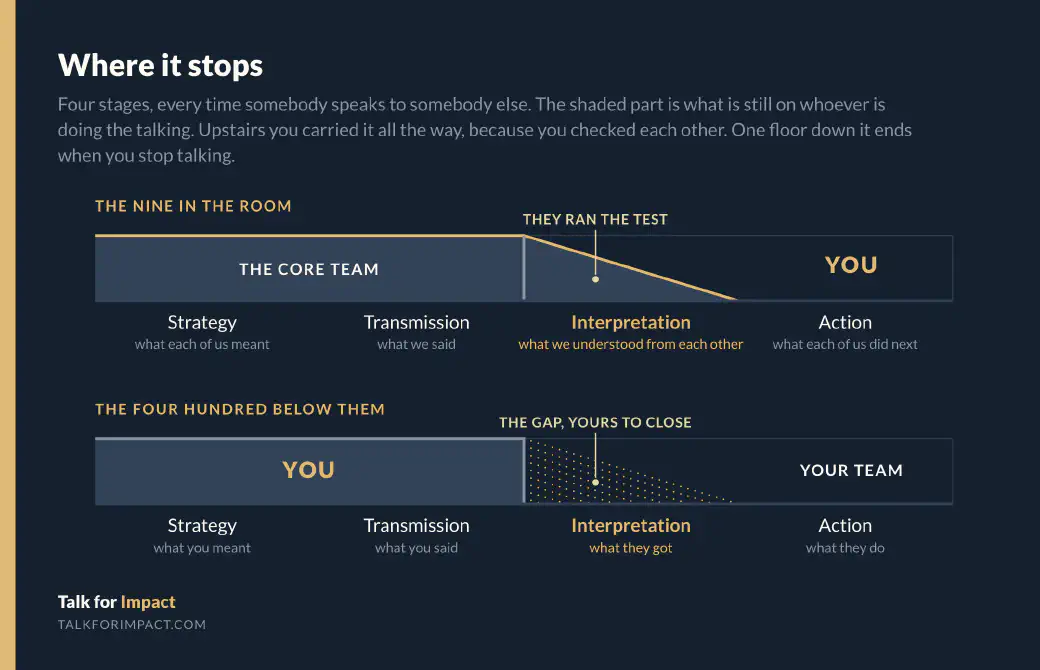
The Interpretation Gap is the distance between what a leader means and what their organisation actually does. It is not a comprehension failure. People can understand a message perfectly well and still act on their own reading of it, filtered through their motivation, their incentives and their situation. Being understood is the halfway point, not the finish line.
What is a High Stakes Leadership Event?
An occasion already in a leader's diary where the reading carries consequence: a board update, an all-hands, an investor call. It is not only the meeting. It is the pack that goes out beforehand, the room itself, and what gets written afterwards.
What is the CRAFT Method?
Five steps for getting a message to land as intended. Clarity, what this has to change in them. Reception, how you will be read by each of the people receiving it. Architecture, how to say the right thing at the right time. Friction, where the most reasonable reading is not the intended one. Truth, the moment when the room reads you before it reads the message.
What is a Landing Scan?
The reading taken after a message has gone out, of what the organisation actually took from it. It is the element that closes the loop, because what it finds feeds the next event rather than the one just finished. That return is what turns the method into a practice.
What is CRAFT 91?
A thirteen-week programme built around three High Stakes Leadership Events already in your diary. Five sessions, a preparation report and cue cards before each event, a debrief and a Landing Scan after each one, and an interpretation profile you keep at the end.
Questions leaders ask
Every question here is reasonable, and I have heard each one from a leader who was right about most things.
This isn't a communication problem. The plan is wrong for the situation.
If everybody moved in the same direction and it still failed, the plan was wrong. If they went in different directions, then whatever they were executing was not the plan. Look at the last one that underdelivered and ask which it was.
Communication is the cherry on the cake. Get the right people, systems and incentives and it takes care of itself.
It does not take care of itself. You take care of it, in the rooms where you are, without calling it anything. That holds until the organisation is bigger than your calendar. The parts you never see then run on their own reading of you. Get the people and the systems right and you get an organisation that can execute. What it executes is still whatever they interpreted.
It isn't all mine. Surely it's fifty-fifty.
Interpretation happens in their mind, but is co-created with you. And the fifty-fifty is not where we usually put it. The sending is a hundred per cent yours, and what they finally do with it is a hundred per cent theirs. The fifty-fifty sits in the gap between the two, and it is not a turn each. It happens at the same time, while they are making sense of what you said, and you can only do your half while it is happening. You cannot control how you are read. You can make the reading you intended the easiest one available, and that is most of the distance.
This is coaching. Presentation training. Not for me.
You have probably had the training. It works, and it is not what fails. You say something well built and the room hears a threat where you meant firmness. Nothing in the delivery caused that. Delivery help sits inside this too, when a moment calls for it, after we have built the message. Polishing something unresolved only makes the wrong thing smoother.
I don't have time.
You were going to prepare for that board meeting anyway. Those hours are already in your calendar, spent alone, the night before, with nobody to tell you how it will read. The sessions go where that preparation already happens. The reports and the profile arrive without a meeting. And when the work is done before the hour is up, we stop.
Am I buying you, or a system?
Today, me. I run the sessions and I'm not going to pretend otherwise. What you keep is not me. The method is written down, the person answering you overnight is already someone else, and the profile you leave with goes on working after the thirteen weeks.
Our strategy keeps changing. Is this the right time?
It changes. It will change again while we are working. When it does, your organisation is holding the old version and receiving the new one at the same time, and people start deciding for themselves what you meant. A shifting strategy is the hardest interpretation problem you will get. We do not decide what you should say. We make sure what you decide is what arrives.
Still the wrong question?
If the one you have is not here, it is worth an hour rather than a page.
Sixty minutes, no charge